

Law360 doesn’t typically remove court records automatically, but you can still request a review or redaction. If the story includes a factual error, sealed information, or a case that was later dismissed or expunged, Law360 may consider updating or editing the content.
If you can provide an official court order confirming that a record has been sealed, Law360 may review your documentation and agree to remove identifying details.
If no legal basis exists, utilizing a court record removal service or suppression strategy is often the best solution to limit visibility in Google.
This information is not legal advice. For legal guidance, consult an attorney in your state.
What Is Law360?
Law360 is a U.S. legal database and news publication owned by LexisNexis. It reports on court filings, verdicts, and regulatory matters and is widely used by legal professionals. Although most of their articles are paywalled and subscription-based, its headlines and article summaries often appear publicly in Google searches, where they can remain visible for years after a case concludes.
How to Request Removal from Law360
1. Find the Record
Search for your court record or an article discussing it. Copy the link, headline, and publication date.
2. Check for Accuracy
Confirm that the court record and article includes no factual mistakes or references to sealed or confidential material. Collect court documents that verify your position, such as dismissal orders or sealed-record confirmations.
3. Submit a Request
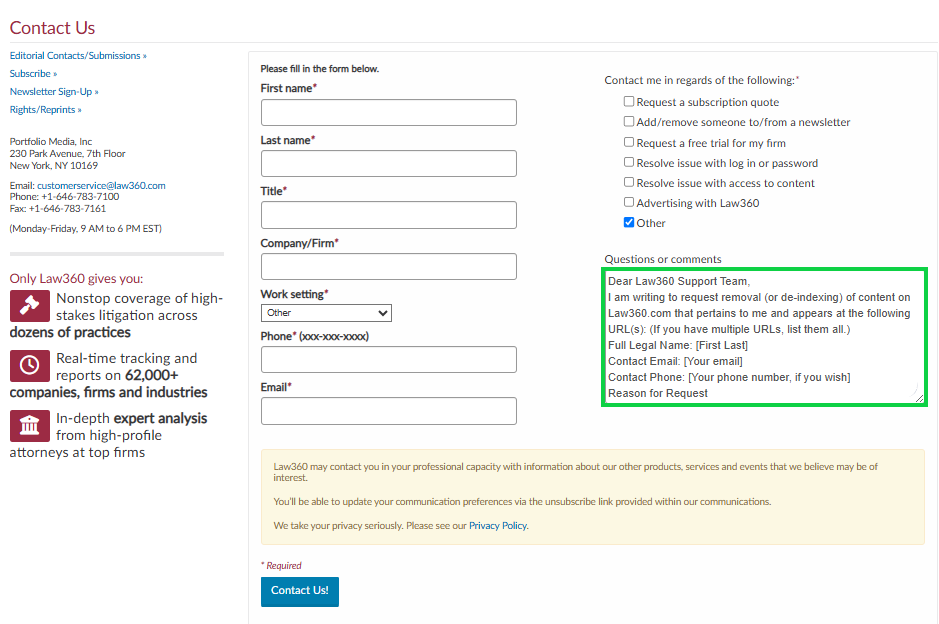
Use the contact form on Law360’s website to ask for a correction or redaction. You can also send an email to [email protected]. Below is an example of a request message. Be sure to include the following:
- The court record link.
- A short, factual explanation of your request.
- Any supporting documentation that proves the change is valid.
4. Provide Legal Proof When Applicable
If a court has sealed or expunged your record, attach the official order. This is often the strongest basis for an update or partial redaction.
5. Save All Records
Keep screenshots, confirmation emails, and submission dates for your records. These details provide proof of your request and help track progress over time. If Law360 or another platform follows up, having this documentation makes it easier to respond quickly and verify what’s already been submitted.
6. Allow Time for Review
Law360 may take several weeks to review and respond to your request. During this time, it’s essential to remain patient while also being consistent with your follow-ups. If you haven’t received a response after a reasonable period, send a polite reminder. Include your original request details and any reference numbers or confirmation emails.
7. Seek Help if Needed
If no progress is made, a reputation-management expert or attorney can resubmit your request with proper supporting documentation.
Once Law360 confirms that a noindex tag has been applied, you can speed up removal from search results using Google’s Outdated Content Tool. Simply enter the Law360 URL and follow the prompts to request that Google refresh its index quickly.
What If Law360 Will Not Remove It?
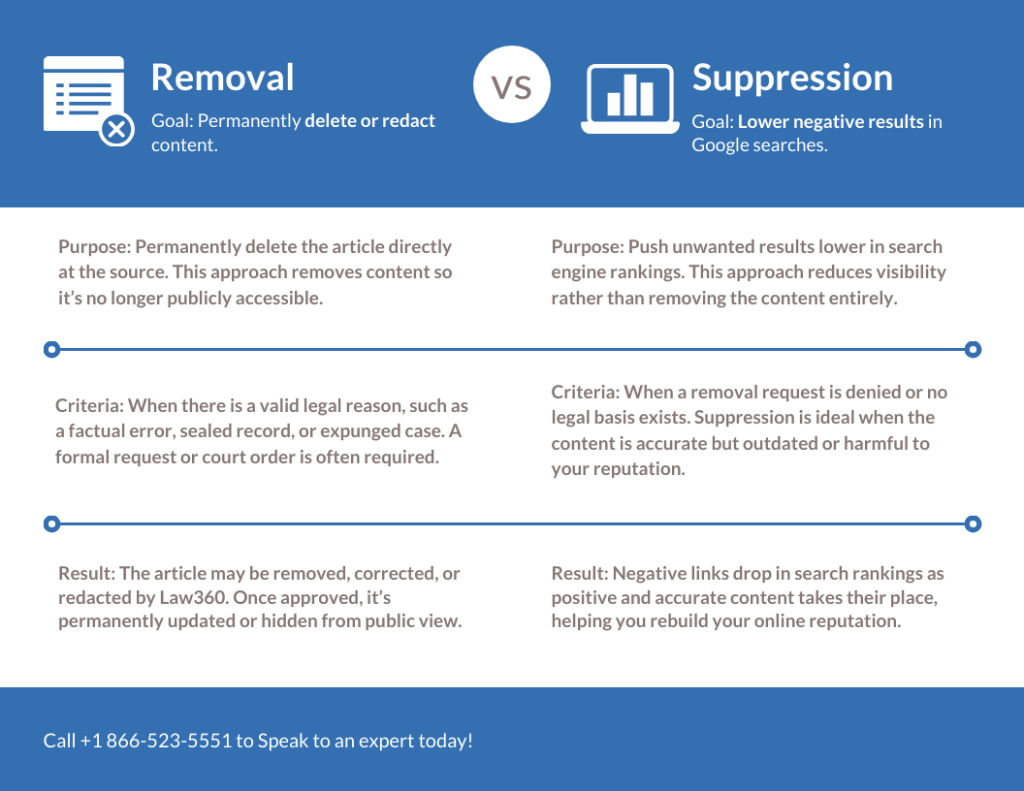
When a removal request is denied, suppression is the most practical solution. Suppression helps reduce the visibility of unwanted or outdated court records and articles in search results. Instead of trying to delete the content, the goal is to make it harder to find. This is done by promoting accurate, positive, and up-to-date information about you or your business.
At Guaranteed Removals, we utilize proven SEO and reputation management strategies to achieve this. Our team studies which search terms bring up the Law360 record and builds a plan to outrank it. We create and optimize positive digital assets such as websites, professional profiles, press releases, and news articles that share accurate information.
As these new pages gain strength, they begin to appear higher in Google results. The Law360 court record or article moves down the list, making it less visible to anyone searching your name. Over time, this approach not only reduces the impact of negative content but also builds a stronger, more trustworthy online presence.
When removal isn’t possible, suppression offers a reliable, long-term way to restore and protect your reputation.
Law360 Removal vs. Suppression
Legal Options or Expungement
If your record qualifies for expungement or sealing, you can ask the court to remove or limit public access to your case. Once the court approves, you can use the sealing or expungement order to request that Law360 remove your name or redact specific details from the court records.
Expungement laws differ by state, and eligibility depends on the type of offense and the outcome of the case. It’s important to confirm your eligibility with a licensed attorney before submitting a request. This ensures that your request is valid and has the best chance of success.
This information is not legal advice. For legal guidance, consult an attorney in your state.
How Long Does Removal Take?
Timelines can vary depending on the details of your case and Law360’s review process. Some requests for de-indexing may be resolved automatically within several hours. For full removal, it can take anywhere from a few weeks, while others can take longer if additional verification or documentation is required. It’s important to remain patient and keep track of any updates or correspondence during this time.
- Initial review: 2 to 4 weeks
- Verification of court orders: 4 to 8 weeks
- Search engine updates: Up to 90 days after Law360 makes changes
Suppression can begin immediately and typically shows visible results in 30 to 60 days, depending on search-engine indexing cycles.
FAQs
Can Law360 delete my name if my case was dismissed?
Sometimes. If a dismissal changes the factual accuracy of the court record or article and you provide proof, Law360 may consider an update or redaction. However, they are under no obligation to remove a story if it remains factually correct at the time of publication.
Will deleting my record from court databases remove it from Law360?
No. Law360 maintains its own editorial archive and does not automatically update stories when public court databases change. A separate request must be submitted directly to Law360 with evidence of the update.
Does Law360 follow right-to-be-forgotten laws?
No. These laws apply to European Union countries, not the United States. Law360 operates under U.S. freedom-of-press principles, so it typically retains published material unless there is a legal requirement to modify it.
If the court record is behind a paywall, can it still affect my reputation?
Yes. Even paywalled content can appear in Google’s index through headlines or cached summaries. Potential employers or clients may still see the case title and your name, which can influence perception even if the full court record or discussion article is inaccessible.
Can Guaranteed Removals help if Law360 refuses my request?
Yes. Guaranteed Removals offers suppression and content-replacement strategies designed specifically for legal publications. We work to lower the ranking of unwanted results and highlight verified, positive content that better represents your reputation.


