


Can You Remove Records from FindLaw?
FindLaw occasionally removes or redacts case summaries if they cause demonstrable harm and are no longer in the public interest. However, removal approval is rare and typically requires clear proof that the court record is sealed, inaccurate, or no longer public.
If you have supporting evidence, such as a sealing order or documentation showing that the record has been restricted, FindLaw may consider your request. However, when trying to remove court records online across multiple databases, suppression is often the most practical backup option to limit visibility in search results.
This information is not legal advice. For legal guidance, consult an attorney in your state.
What Is FindLaw?
FindLaw is an online legal information resource owned by Thomson Reuters. It provides attorney directories, legal articles, and public case information pulled from official sources.
Because the site’s case summaries are indexed by Google, your name or case may appear in search results long after a matter is resolved or dismissed.
How to Request Removal from FindLaw
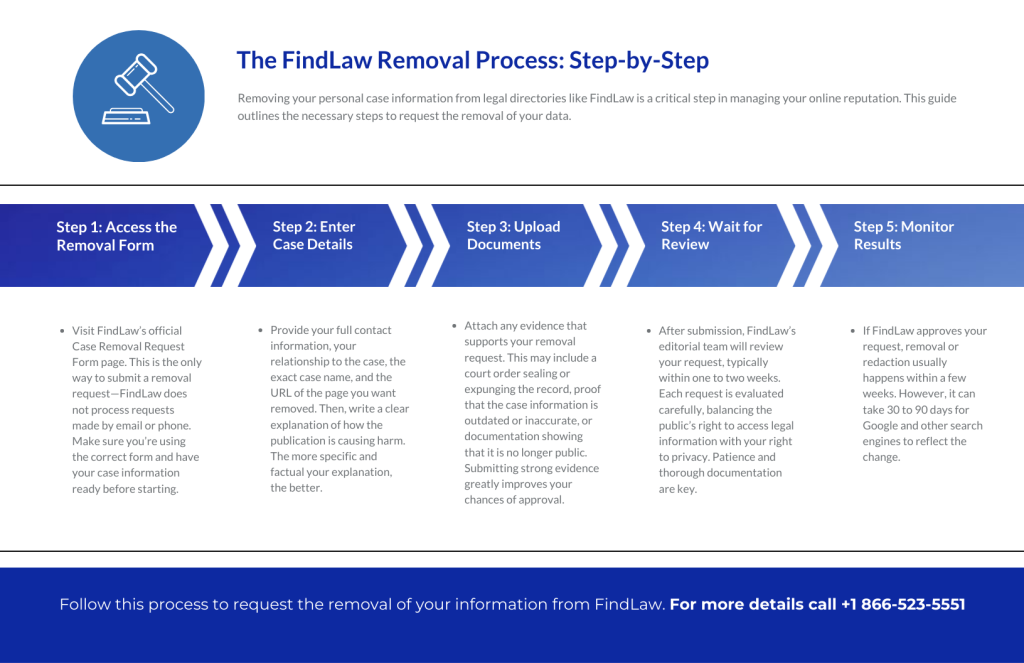
1. Complete the Case Removal Request Form
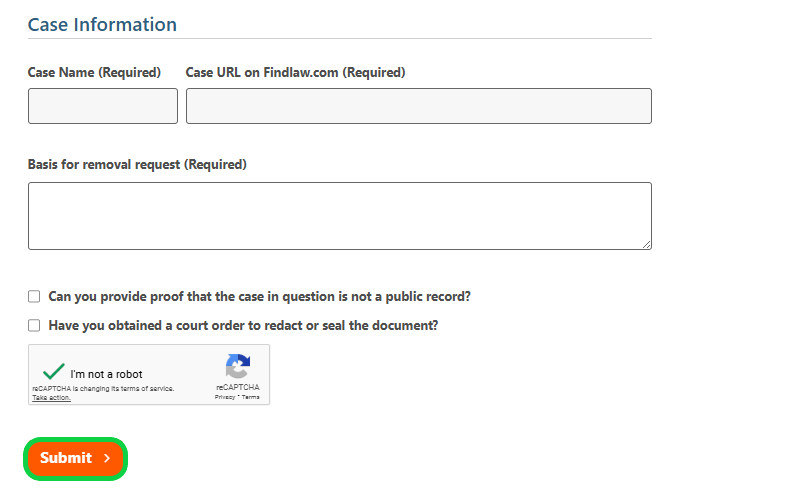
Go to FindLaw’s official Case Removal Request Form page and submit your request. You will need to provide:
- Your contact details and your relationship to the case
- The full case name and page URL
- A detailed explanation of your removal request, including any harm caused by publication
2. Include Supporting Documentation
Requests are more likely to succeed if you include verifiable evidence such as:
- Proof that the case is no longer public
- A court order sealing or redacting the record
- Any other documentation showing inaccuracies or potential harm
3. Wait for Review
According to the site, you should receive a follow-up email from their team after within 1-2 weeks of submitting your case.
What If FindLaw Will Not Remove It?
If your request is denied, suppression is the most effective alternative. Suppression focuses on lowering the ranking of the FindLaw page in search results by strengthening and optimizing positive content.
Guaranteed Removals uses proven online reputation management strategies to ensure that accurate and favorable pages replace outdated or negative listings from FindLaw.
Legal Options or Expungement
If your record qualifies for expungement or sealing, you can file a motion with the court to have it formally restricted. Once the order is approved, submit it to FindLaw as part of your Case Removal Request Form.
Expungement laws vary by state and case type, so it is best to consult a licensed attorney before filing.
For more information, see the U.S. Courts guide on record sealing and expungement.
This information is not legal advice. For legal guidance, consult an attorney in your state.
How Long Does Removal Take?
FindLaw reviews removal requests within 1 to 2 weeks of submission. If the request is approved, removal or redaction typically occurs within several additional weeks.
After an update, it may take 30 to 90 days for Google and other search engines to reflect the change. You can help speed this up using Google’s Outdated Content Tool.
FAQs
How likely is FindLaw to remove a case?
FindLaw rarely removes cases unless there is a strong legal basis, such as a sealed or expunged record, or documented evidence of harm caused by publication.
Can I contact FindLaw directly without using the form?
No. All case-related removal requests must be submitted through the official Case Removal Request Form to be reviewed. This ensures that FindLaw’s editorial team has all the necessary details and documentation to properly evaluate your request.
Will FindLaw remove my record if my case was dismissed?
Not automatically. You must show that the dismissal makes the published record inaccurate or no longer in the public interest. Providing documentation that proves the case was resolved or dismissed can strengthen your request and increase the chances of removal approval.
Does FindLaw comply with privacy or right-to-be-forgotten laws?
No. As a U.S.-based legal information site, FindLaw operates under U.S. public record and free-press laws. This means it is not bound by European-style privacy or “right to be forgotten” regulations, and information that is publicly available through the courts generally remains accessible on the site.
Can Guaranteed Removals help if FindLaw denies my request?
Yes. Guaranteed Removals can assist with suppression strategies to reduce visibility of FindLaw listings in Google and replace them with positive, verified content.


