TALK TO AN EXPERT1-866-523-5551

Colorado Mugshot Law: What You Need to Know

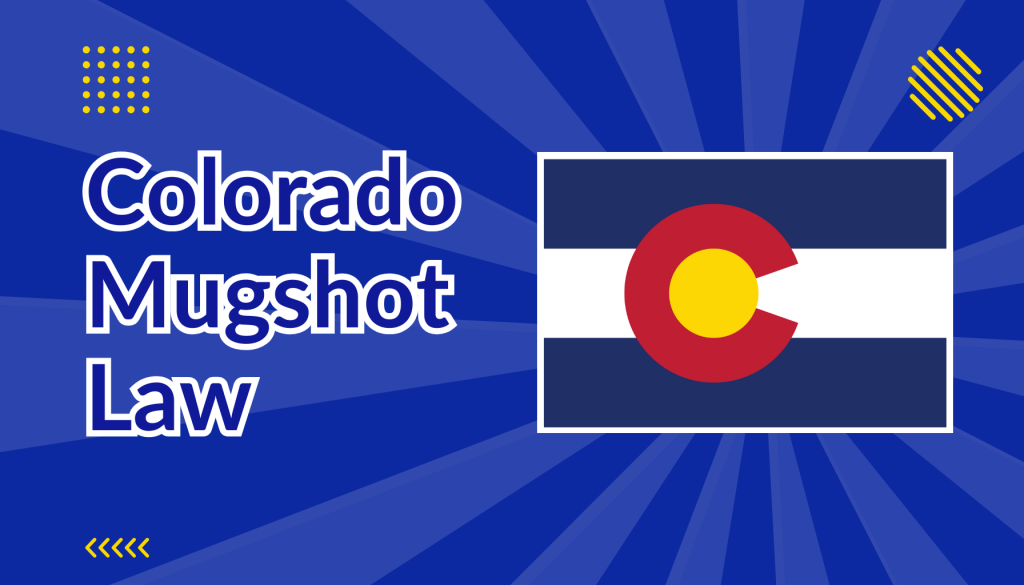
Colorado Mugshot Law beside Colorado state flag

Colorado took early action against exploitative mugshot websites by passing House Bill 14-1047 in 2014. This law made it illegal to profit from charging individuals to remove their mugshots and gave Colorado residents strong legal tools to demand takedowns.

Here’s what the law says, who it helps, and how to use it if your mugshot is online.

Want to know more about mugshot laws? Check out our full article on Mugshot laws across the U.S.

What Colorado's Mugshot Law Covers

House Bill 14-1047 specifically targets the business model used by sites that publish mugshots and then charge removal fees. The law focuses on both the websites and those who try to obtain mugshots for resale.

Under this law:

  • Mugshots must be removed for free if the individual:
    • Was never charged
    • Had their charges dismissed
    • Was found not guilty in court
  • Refusing to remove the mugshot can lead to:
    • A civil lawsuit from the affected individual
    • A fine of up to $1,000 per violation
  • It’s a misdemeanor offense to request mugshots from law enforcement with the intent to post them on pay-to-remove websites.
  • Requesters must sign a sworn affidavit confirming they won’t use mugshots for commercial removal schemes if they want access from law enforcement.

Looking for a broader or more specific solution? Start with our full guide on how to remove mugshots from Google.

HOUSE BILL 14-1047
CONCERNING RESTRICTIONS ON THE PUBLISHING OF BASIC IDENTIFICATION INFORMATION ON COMMERCIAL WEB SITES

BY REPRESENTATIVE(S): Becker, Court, Fields, Fischer, Ginal, Hamner, Hullinghorst, Kagan, Labuda, McLachlan, Melton, Mitsch Bush, Moreno, Pettersen, Primavera, Ryden, Salazar, Schafer, Singer, Williams, Young, Kraft-Tharp;
ALSO SENATOR(S): Guzman, Aguilar, Heath, Jahn, Johnston, Jones, Kefalas, Kerr, Newell, Nicholson, Schwartz, Todd, Zenzinger.

SECTION 1

In Colorado Revised Statutes, amend 24-72-305.5 as follows:

24-72-305.5. Access to records – denial by custodian – use of records to obtain information for solicitation – definitions.

Records of official actions and criminal justice records and the names, addresses, telephone numbers, and other information in such records shall not be used by any person for the purpose of soliciting business for pecuniary gain. The official custodian shall deny any person access to records of official actions and criminal justice records unless such person signs a statement which affirms that such records shall not be used for the direct solicitation of business for pecuniary gain.

(a) It is unlawful for a person to obtain a copy of a booking photograph in any format knowing:
    (I) The booking photograph will be placed in a publication or posted to a website; and
    (II) Removal of the booking photograph from the publication or website requires the payment of a fee or other exchange for pecuniary gain.

(b) A person who requests a copy of a booking photograph from an official custodian shall, at the time of making the request, submit the statement required by subsection (1) of this section. By signing the statement, the person is affirming that the booking photograph will not be placed in a publication or posted to a website that requires the payment of a fee or other exchange for pecuniary gain in order to remove or delete the booking photograph from the publication or website.

(c) Notwithstanding the provisions of section 24-72-309, a person who violates a provision of paragraph (a) of this subsection (2) or who submits a false statement pursuant to paragraph (b) of this subsection (2) commits an unclassified misdemeanor and shall be punished by a fine of up to one thousand dollars.

(d) As used in this subsection (2), unless the context otherwise requires, “booking photograph” means a photograph or other image of a person taken by a criminal justice agency at the time that a person is arrested or detained by a criminal justice agency and prior to conviction.

SECTION 2

Act subject to petition – effective date – applicability.

This act takes effect September 1, 2014; except that, if a referendum petition is filed pursuant to section 1(3) of article V of the state constitution against this act or an item, section, or part of this act within the ninety-day period after final adjournment of the general assembly, then the act, item, section, or part will not take effect unless approved by the people at the general election to be held in November 2014 and, in such case, will take effect on the date of the official declaration of the vote thereon by the governor.

This act applies to offenses committed on or after the applicable effective date of this act.

Why The Colorado Mugshot Law Matters

Before this law, mugshot websites could profit even if someone was never convicted. They used public records to publish arrest photos and charged hundreds of dollars for removal, even in cases of dropped charges or mistaken identity.

Colorado’s law was one of the first in the country to directly fight this practice. It gave people legal rights to fight back and discouraged the commercial use of mugshots altogether.

It also shifted the responsibility to website operators: if they publish a mugshot, they must remove it for free if the arrest doesn’t result in a conviction.

Who the Colorado Mugshot Law Protects

The law is especially helpful if:

  • You were arrested but never charged
  • Your charges were dropped or dismissed
  • You went to court and were found not guilty
  • Your mugshot is showing up on websites trying to make you pay for removal

If your situation fits one of these categories, you can demand free removal under Colorado law. If the site refuses, you can file a lawsuit and pursue damages.

Enforcement: What You Can Do

If you find your mugshot online and believe the site is violating Colorado law:

Document Everything
Take a screenshot of the mugshot, the date, and the URL.

Check Eligibility
Gather proof your charges were dismissed, dropped, or never filed.

Send a Formal Removal Request
Let the website know they’re legally obligated to take it down. You can cite Colorado HB 14-1047.

Consider Legal Action
If the site ignores you, you may be entitled to up to $1,000 per violation, plus court costs.

How to Remove Your Mugshot in Colorado

1. Contact the Website

  • Ask for voluntary removal, especially if the case was dismissed or sealed.
  • Include proof of dismissal or expungement if available.

2. Check Google’s Removal Tools

3. Seek Legal Help

  • If a site is demanding money, consult an attorney. Some practices may rise to the level of extortion.

4. Work with a Reputation Management Expert

  • For long-term cleanup, professionals like our team at Guaranteed Removals can help suppress the content from search results.

FAQs About Mugshots in Colorado

Is it illegal to publish mugshots in Colorado?
No, publishing mugshots is not illegal. But charging people to remove them is.

Can I sue a website that won’t take my mugshot down?
Yes, if you qualify under the law (never charged, dismissed, or acquitted), you can file a civil lawsuit and seek up to $1,000 per violation.

Can police still release mugshots?
Yes, but anyone requesting mugshots from law enforcement must sign an affidavit promising not to use them for profit.

Does this apply to expunged records?
Yes, if your case was expunged, sealed, or dismissed, you have grounds for removal under the law.

Get Started With Our Mugshot Removal Service today

Guaranteed Removals Mugshot Removal Service

Guaranteed Removals Mugshot removal service focuses on removing mugshots and criminal records from the internet, Google and other search engine providers. Our services aim to enhance your online reputation and build trust.

There is no obligation or risk. You only pay after we permanently remove the negative content from the source.

Get started and take control of your online presence today.

Learn more about removing mugshots from the internet

Picture of Travis Schreiber
Travis Schreiber
Travis Schreiber is a reputation management expert with extensive experience helping individuals and businesses protect their online presence.