


When a court record is listed under your name, the harm usually comes from visibility, not access. Even if the record is legally public or a publisher refuses to delete it, you can still protect your reputation by reducing how often people see it. That is what suppression does.
Suppression is the process of pushing an unwanted result lower in search engines by building stronger, more relevant results above it. The record stays online, but it becomes far less likely to appear where it can impact your life.
What Suppression Actually Means
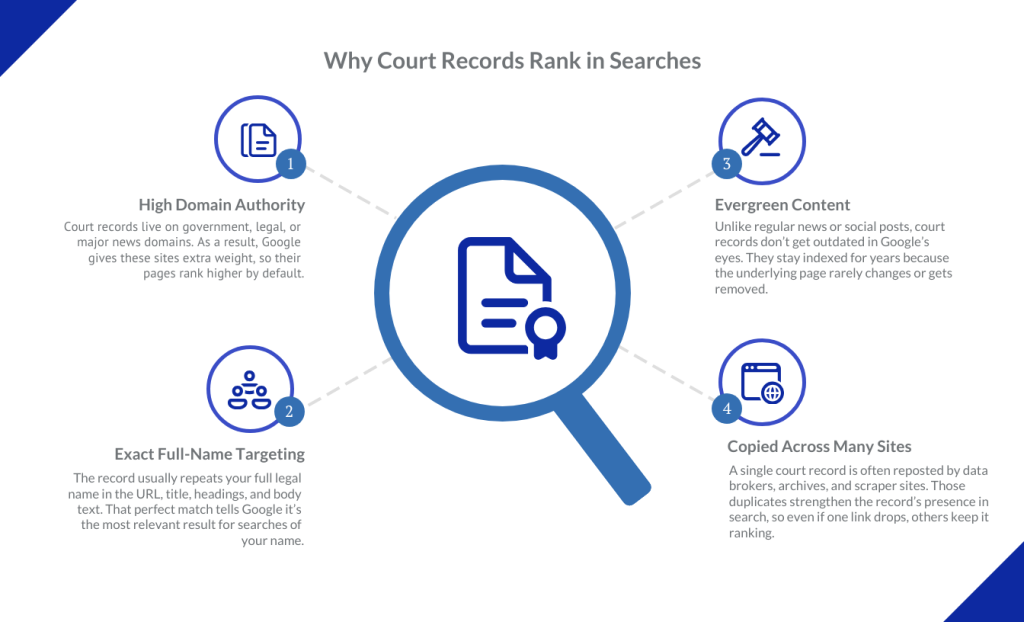
Search engines rank pages based on relevance and authority. If a court record appears high in results, it is usually because:
- The site hosting it has strong authority
- The record is closely tied to your name
- There are not enough credible alternatives about you
Suppression fixes that imbalance by providing search engines with better, more accurate results to display first. Suppression works by giving search engines stronger, more accurate pages to rank above the record, and Google’s SEO Starter Guide outlines the relevance and authority signals that make that possible.

When Suppression Is the Right Strategy
Suppression is most useful when removal is delayed, denied, or not legally available. This commonly applies if:
- The record is still publicly reportable
- The publisher refuses to delete the page
- The record appears on a high-authority legal or news site
- Copies of the record keep resurfacing elsewhere
Even when a record is publicly available through official systems such as the federal court records network (PACER) run by the United States Courts, suppression can still reduce its appearance in name searches.
Step 1: Identify the Results You Need to Push Down
Start by searching for your name as others would, and save the specific URLs that contain the court record. Check a couple of variations (name + location, name + case wording) so you understand the full footprint.
Your goal here is simple: know exactly what is ranking before you try to change it.
Step 2: Build Strong Results That Represent You
Suppression is effective when search engines have credible alternatives. Focus on a small set of high-quality assets tied clearly to your identity, such as:
- A professional profile
- A personal or business website
- A public bio or portfolio page
- Well-maintained social profiles
You do not need dozens of pages. You need a few legitimate, consistent ones that are clearly about you.
Step 3: Add One or Two Pieces of Ranking Content
Once your core profiles are established, publish content that can compete directly with the record page. The best options are practical and name-relevant, like:
- An “About” or biography page
- A professional overview of your work
- A personal statement that reflects who you are today
The content should be real and useful. Search engines rarely elevate thin filler above authoritative record sites.
Step 4: Support Those Pages With Basic SEO Signals
You are not trying to game search engines. You are making it easy for them to understand what should rank for your name. That usually means:
- Your full name appears naturally in key headings
- The first paragraph makes clear who the page is about
- Your assets link to each other where relevant
- Pages are public and indexable
These small foundations significantly improve suppression performance.
Step 5: Monitor Progress and Strengthen What Works
Suppression improves over time. Track whether the record drops and which of your pages rise. If progress slows, the fix is usually:
- Stronger content on more credible platforms
- Clearer relevance to your name
- Better consistency across assets
Quality and authority matter more than volume. Google Search Console is the official tool for monitoring whether your pages are being indexed, how they perform in search, and which queries are driving visibility.
Common Mistakes That Slow Suppression
Suppression often fails when people rely on weak or inconsistent sources of information. Avoid:
- Using mismatched names or identity details
- Duplicating the same text across multiple pages
- Publishing low-value placeholder content
- Focusing on one profile and expecting it to do all the work
A clean, aligned online footprint is what reliably pushes negative results down. When accurate, high-trust content about you exists across credible sources and clearly matches your name, Google has stronger alternatives to rank above the harmful link. Without that, the negative result keeps returning to the top.
How Guaranteed Removals Helps
Guaranteed Removals uses suppression as a proven solution when deletion is not possible. That work includes identifying what is ranking, building credible alternatives that search engines prefer, and refining the strategy until harmful results lose visibility.
The objective is straightforward: ensure accurate, current results represent you, and court record visibility becomes minimal.
Where to Go From Here
Suppression is about restoring control of your search results. If removal is available, it should be pursued first. If it is not, suppression offers a reliable path to protecting your name by making the record difficult to find.
FAQs
What’s the difference between court record suppression and court record removal?
Removal aims to delete the page or deindex it so it’s no longer accessible or visible in search. Suppression keeps the record online, but pushes it lower by outranking it with stronger, more relevant results tied to your name.
How long does court record suppression take to work?
It depends on what you’re fighting. If the record is on a high-authority legal or news site, suppression usually takes longer because those pages have strong ranking power. Most progress happens in phases. First, you stabilize your core assets, then you build enough authority for them to climb.
Does suppression work if the record is on a big legal database or a major news site?
Yes. Those are the most common suppression scenarios. The key is competing with authority and relevance using credible pages about you on platforms Google already trusts, with consistent identity signals.
What should I create first for suppression to work?
Start with identity anchors such as a professional profile, a personal or business website, and a few well-maintained social profiles. Suppression usually fails when there are not enough legitimate “about you” pages for search engines to rank.
Is suppression about manipulating search engines?
No. Proper suppression focuses on creating accurate, high-quality content about you on credible platforms. The goal is to help search engines understand which results best represent your identity, not to use tricks or spam to force rankings.
Can Guaranteed Removals do suppression even if deletion is not possible?
Yes. When removal is denied or legally unavailable, the strategy shifts to reducing visibility. That includes identifying the URLs ranking for your name, building credible alternatives search engines prefer, and refining the approach until the negative result loses page-one traction.
Get Started With Our Content Removal Service today
Guaranteed Removals Online Content Removal Service
Guaranteed Removals content removal service focuses on removing fake and unwanted content from the internet, Google and other search engine providers. Our services aim to enhance your online reputation and build trust for you or your business.
There is no obligation or risk. You only pay after we permanently remove the negative content from the source.
Get started and take control of your online presence today.
