


PlainSite publishes public court records, making them easily accessible through search engines. In most cases, removal is possible only when a court record has been sealed, expunged, or removed from the official source.
If you can provide legal proof that your record is no longer public, PlainSite may consider removing or updating the page. Otherwise, suppression is the most effective solution to reduce its visibility in Google search results.
This information is not legal advice. For legal guidance, consult an attorney in your state.
What Is PlainSite?
PlainSite is an online transparency platform that collects and republishes public court documents, case filings, and docket information from federal and state courts. While it aims to make legal data more accessible, this also means that personal or sensitive case details may appear in search results for years after a matter is resolved.
How to Request Removal from PlainSite
1. Locate Your Record
Go to plainsite.org and search your name. Copy the case link, docket number, and case title exactly as listed.
2. Confirm the Source of the Record
Check whether the record is still available in the original court database, such as PACER or your state court’s website. If it has already been sealed or removed there, you may have grounds to request PlainSite to remove it.
3. Gather Documentation
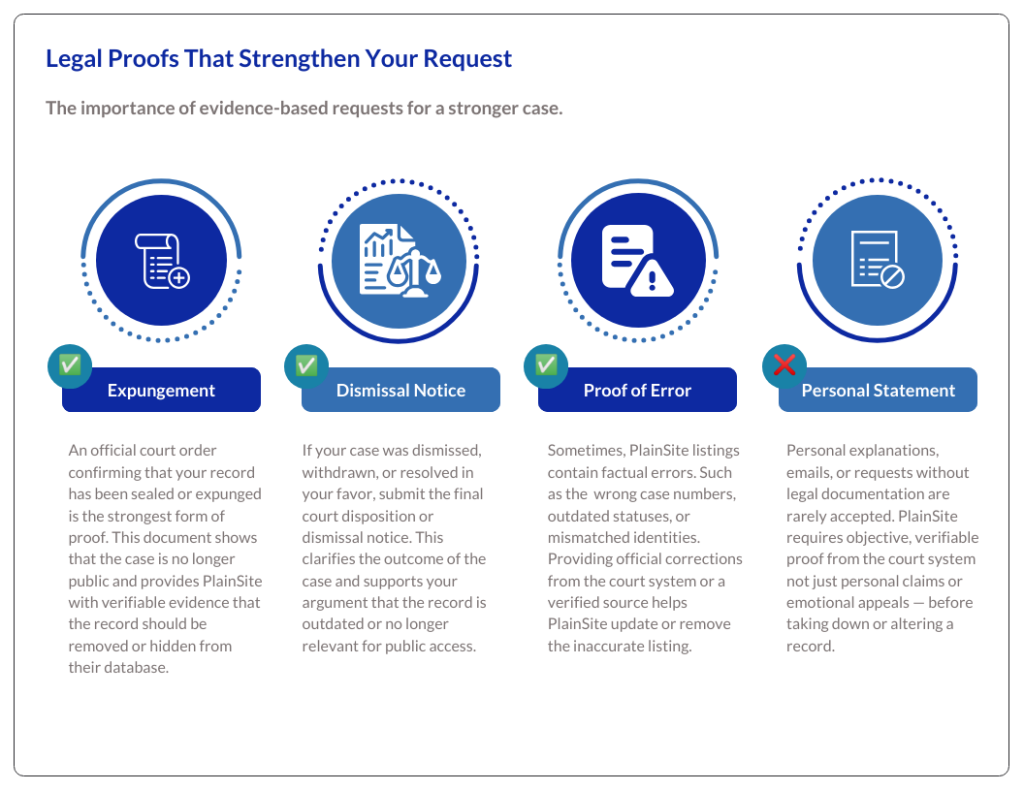
Collect official proof that your record has been sealed, expunged, or dismissed. This can include a court order or a case disposition notice.
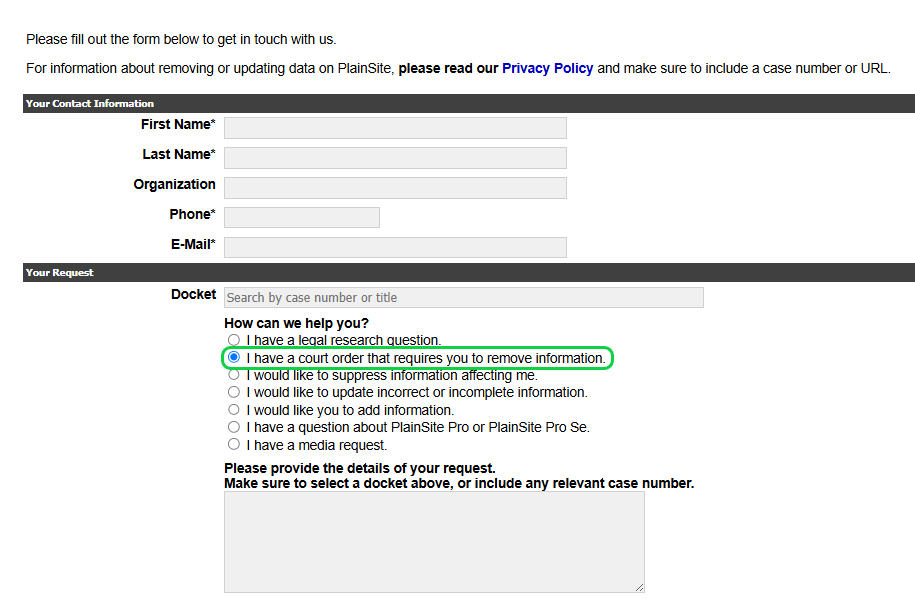
4. Submit a Request to PlainSite
Use their contact form to request removal. Include:
- The full URL of the record
- A brief explanation of why it should be removed or redacted
- Legal documentation supporting your request
5. Be Clear and Professional
Keep your message concise and factual. PlainSite is more likely to respond to requests backed by verified legal evidence.
6. Follow Up if Needed
Wait several weeks for a response. If you do not hear back, a reputation management specialist can follow up on your behalf.
Legal Options or Expungement
If your record qualifies for expungement or sealing, you can petition the court to restrict public access. Once the court approves it, use the official sealing order to request PlainSite remove or update the listing.
In many states, individuals can pursue record relief, a legal process that includes expungement, sealing, or setting aside certain criminal records. These measures restrict public access to case information, meaning once a record is sealed or expunged, websites like PlainSite can no longer legally display it. Record relief eligibility varies by state and type of offense, but obtaining it is often the first and most effective step toward permanent online removal.
Expungement laws vary by state, so it is best to consult a licensed attorney to confirm eligibility and gather proper documentation.
For general guidance, see the U.S. Courts resource on expungement (PDF).
This information is not legal advice. For legal guidance, consult an attorney in your state.
Legal Proof That Improve Your Removal Requests
What If PlainSite Will Not Remove It?
If PlainSite denies your request, the next step is suppression. Suppression focuses on pushing the unwanted record off the first page of Google by improving and promoting more relevant, positive content.
Guaranteed Removals uses proven online reputation management methods to suppress outdated or harmful records. Our strategies highlight accurate, up-to-date information that reflects your current reputation rather than past legal issues, providing a smooth transition to our professional court record removal service if direct outreach fails.
How Long Does Removal Take?
Timelines depend on PlainSite’s review process and the court involved.
- Verification and documentation: 2 to 4 weeks
- PlainSite review: 4 to 8 weeks
- Google deindexing: up to 90 days after removal
You can also request faster indexing updates through Google’s Outdated Content Tool once PlainSite confirms any updates.
FAQs
Can PlainSite delete my record if my case was dismissed?
Only if you can prove that the record was removed or sealed in the court database. PlainSite republishes public data and generally only removes content that is no longer publicly available.
Will removing my record from PACER also remove it from PlainSite?
Not automatically. PlainSite may need to verify that the original record has been taken down manually. Submitting official proof of removal helps speed up this process.
Does PlainSite honor privacy or right-to-be-forgotten requests?
No. As a U.S.-based website, PlainSite is not subject to EU privacy laws. It follows the American public record and free-access principles.
Can I edit or hide my listing on PlainSite myself?
No. Users cannot directly modify or hide PlainSite listings. Any changes must go through their support or contact process.
Can Guaranteed Removals help if PlainSite refuses to remove my record?
Yes. Our specialists create custom suppression and content-replacement strategies that reduce the visibility of unwanted PlainSite listings and help your positive results rank higher in search engines.


