

Court records are often available online because most are public by default and are frequently republished by third-party databases. Removing them usually means getting the record taken down or redacted on the sites that host it first, then prompting search engines to refresh their listings. Both parts are essential for permanent court record removal.
1. Find Every Place the Record Appears
Start by identifying each page that contains your record. This is the foundation for any successful removal.
What to do
- Search your full name in quotes, along with your city, county, or case type.
- Try a few name variations (with and without middle initials or hyphens).
- Save every URL that displays the record.
Note what kind of site it is: A legal database, people-search/data broker, background check platform, or news outlet.
Next: Once you know where your record is listed, check our detailed site removal guides with in-depth information about how to remove your court records:
- CaseMine
- CourtListener
- Justia
- Trellis
- Docket Alarm
- DocketBird
- UniCourt
- vLex
- Leagle
- FindLaw
- PacerMonitor
- PlainSite
- Law360
Why this matters:
Court records often spread across multiple sites. If you only remove one copy, another can continue ranking in search results.
2. Confirm Your Case Status
The legal status of your case heavily influences removal options and success.
If the record has been:
- Dismissed
- Sealed
- Expunged
- Resolved under privacy protections
You typically have stronger grounds for removal.
What to gather:
- The final disposition or dismissal documentation
- Sealing or expungement orders
- Court-stamped proof of the current status
Many sites will not consider removal without official confirmation.
3. Submit a Removal Request to the Source Site
Search engines do not own court records. They simply display what is published elsewhere. That means the most effective strategy is to remove the record at the source first.
How to make your request stronger
When a site provides a removal or privacy form, include:
- The specific URLs
- Your full legal name
- A concise reason for removal (sealed/expunged, outdated, inaccurate, privacy-sensitive, etc.)
- Supporting documentation
- A clear request to delete or redact the page
If the site does not have an opt-out
Check for:
- A privacy policy
- A data removal or “contact us” page
- A compliance email address
Some sites will still remove content through direct outreach even if they do not advertise an opt-out process.
4. Know Which Sites Are Easier or Harder to Remove From
Different publishers operate under varying rules, and this affects your next steps.
Sites that are often more cooperative
These platforms may remove or redact a record when:
- The case is sealed, expunged, or dismissed
- The record is outdated
- The information is inaccurate
- Privacy law or policy supports removal
Highly Resistant Sites
Some legal databases and transparency platforms may require a formal court order before removing anything, even if the case is old or resolved.
Important point: A denial does not mean you are out of options. It usually means you need a different strategy.
5. After Removal, Prompt Search Engines to Update
Even after the record is removed from a website, search results may still display an outdated listing temporarily.
What to do next:
- Request a search result update through Google’s search engine’s outdated-content tools.
- If a court order specifically requires removal, include that documentation where applicable.
Search results generally will not disappear permanently until the source page is gone, so removal must come first.
6. If Removal Is Not Possible, Use Suppression
Some records remain public, or the publisher refuses to delete content. In those cases, suppression can still protect your reputation.
Suppression focuses on reducing visibility by strengthening other results tied to your name, such as:
- Professional profiles
- Personal or brand-controlled websites
- Optimized content that ranks more prominently
- Accurate, updated information about you
Suppression does not delete the record, but it can significantly reduce how often people encounter your information in searches.
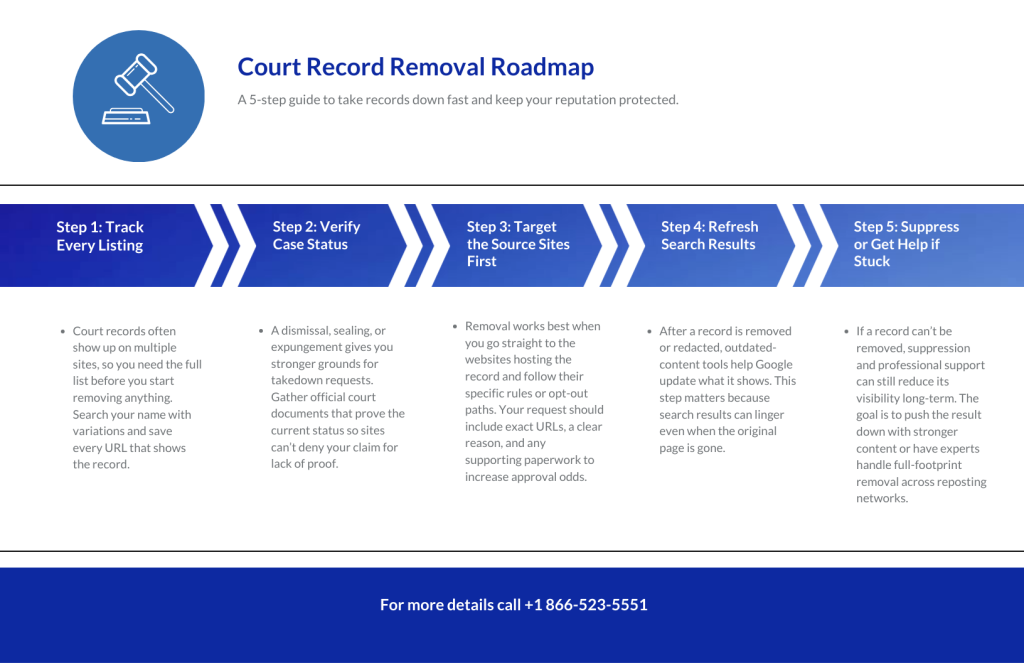
7. When Professional Help Is the Most Effective Route
Self-service removal is realistic in some situations. Professional removal becomes the best choice when:
- The record appears on multiple sites
- Publishers ignore or deny removal requests
- You need an outcome-driven solution
- Your record is sealed or expunged, but still ranking
- The content keeps resurfacing across reposting networks
These situations are common, and they are exactly what Guaranteed Removals is built to address.
How Guaranteed Removals supports removals
- Outcome-based removals: You only pay for records that are successfully removed.
- Comprehensive strategy: Removals target the source, reposting sites, and data broker copies.
- Long-term protection: If the removed content reappears later, it is addressed again under warranty.
FAQs
Can I remove my name from court record websites?
Often, yes. Removal is most realistic when the case was dismissed, sealed, expunged, outdated, or posted inaccurately. Some sites delete the page, while others only redact details. If the record appears on multiple sites, each copy usually needs to be addressed separately.
Can court records be removed from Google?
Search engines reflect what exists on public websites. In most cases, a result will not disappear permanently unless the source page is removed or changed first. Once the source is gone, search listings typically update after reindexing. If the source cannot be removed, suppression can reduce visibility.
What if my record is sealed or expunged, but still shows online?
This is common. Third-party sites do not always update automatically. Submitting removal requests with your sealing or expungement order usually strengthens your case and improves the likelihood of deletion or redaction.
What if my record is still legally public?
Some publishers may refuse removal, but others will act based on privacy policies or relevance standards. When removal is not possible, suppression can still push the record lower in search results and make it much harder to find.
Do I need a lawyer to remove court records?
Not always. Many removals can be handled through publisher requests with proper documentation. A lawyer may be helpful if a site requires a court order or if sealing/expungement must be completed first.
Why do court records sometimes reappear?
Records can be reposted through data-sharing networks or refreshed by repeated scraping. That is why full-footprint removal and ongoing protection matter, especially for widely distributed records.


